
Blog
Custom Rash Guard Manufacturer: BJJ & MMA Sourcing Guide

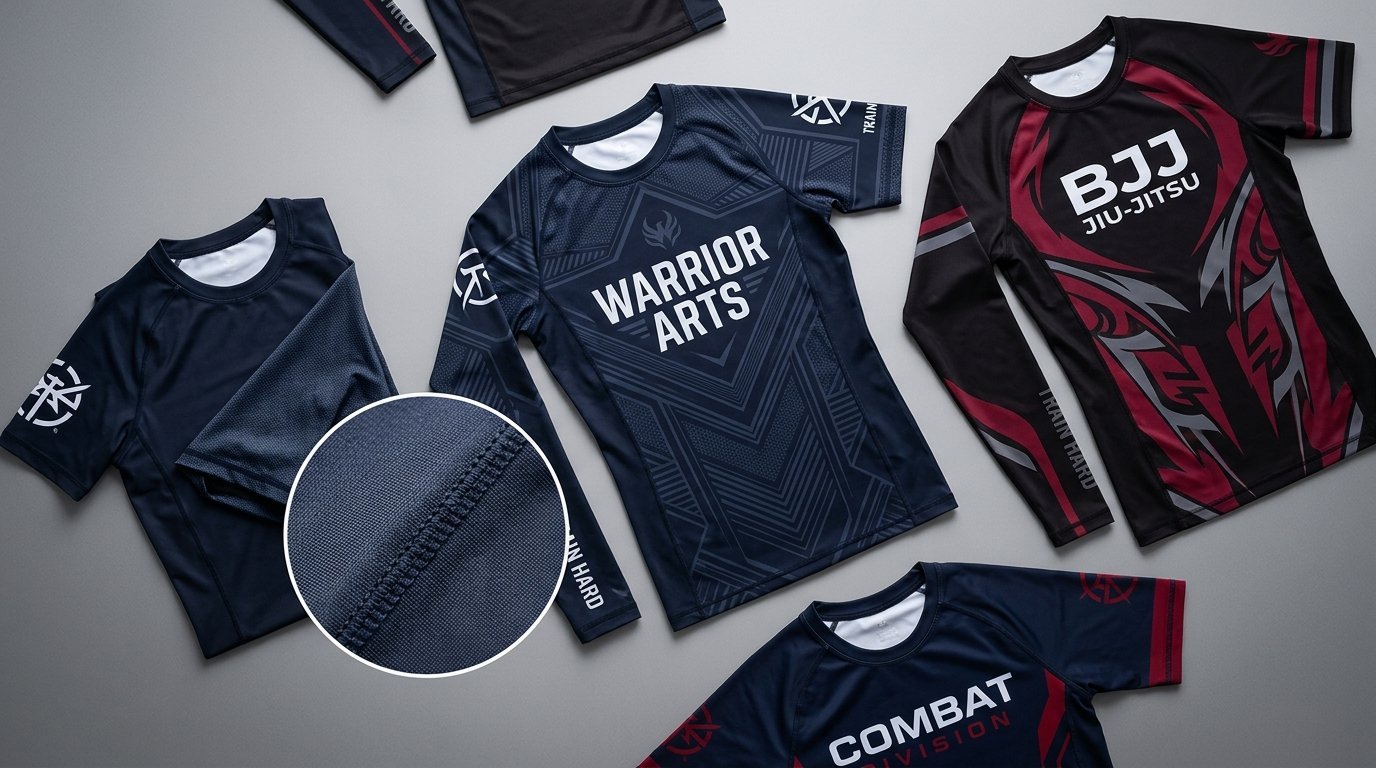
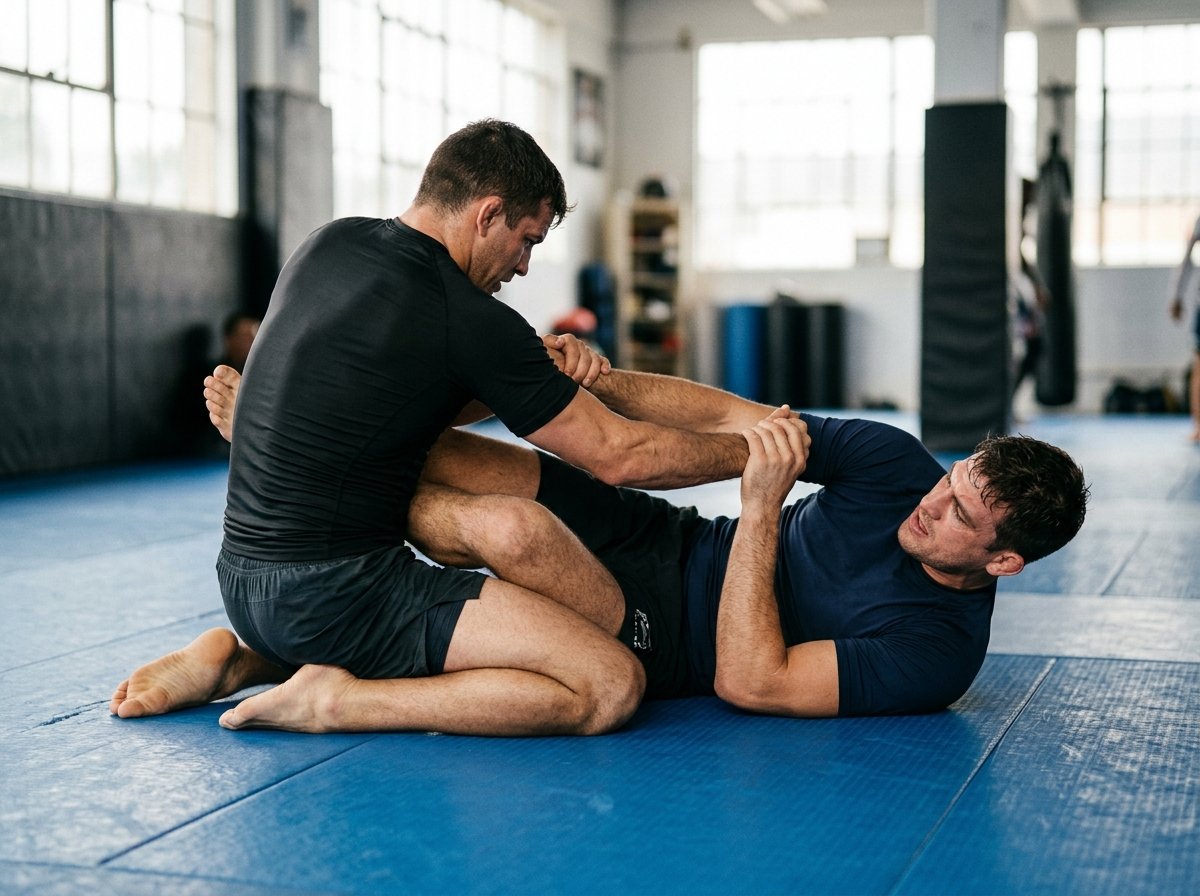
If you are sourcing compression wear for a BJJ academy brand, an MMA fightwear label, or a combat sports import business, the rash guard is one of the most technically demanding garments you will ever spec out. The fabric blend, the stitch construction, the print durability — each one directly determines how long your product lasts under repeated grappling stress, heavy washing, and the constant friction of mat training.
Most buyers approach rash guard sourcing the same way they approach a basic T-shirt order. They request a sample, approve the color, and move on. That is a mistake. A rash guard worn in a hard BJJ roll experiences levels of stretch, sweat saturation, and abrasion that generic activewear simply was not designed to handle. Understanding what separates a rash guard built for competitive grappling from one that fades, tears, or loses shape after ten washes is what this guide is designed to help you with.
Whether you need 100 units under a private label or a 5,000-piece OEM order for a global distributor, knowing your fabric specs, your stitching standards, and your print technology choices before you approach a factory will save you significant money — and significant credibility with your customers.
What Is a Rash Guard — and Why Manufacturing Quality Matters
A rash guard is a close-fitting compression garment made from synthetic stretch fabric, worn primarily in combat sports such as Brazilian jiu-jitsu, MMA, wrestling, and Muay Thai. Unlike a standard compression shirt, a purpose-built rash guard is engineered for sustained contact, high-friction environments, and repeated laundering cycles without significant degradation.
The term “rash guard” originated in surf culture, where the garment protected against wetsuit rash. In combat sports, the function evolved. Today the garment serves three distinct purposes: protecting the skin from mat burns and friction-based abrasions; providing compression support to muscles during training; and acting as a hygienic barrier between the athlete’s skin and training partners when worn under a gi.
From a manufacturing perspective, the quality gap between a well-made rash guard and a poorly made one is significant and visible within the first few months of regular use. Poor seam construction causes chafing and thread separation. Incorrect fabric blends produce a garment that loses compression memory quickly. Inferior sublimation dye processes result in fading within as few as 15 to 20 wash cycles. When you are building a brand in combat sports, these failures translate directly into product returns, social media complaints, and lost repeat orders.
The global market for compression sportswear is growing steadily, driven by the continued global expansion of BJJ academies, the rise of MMA as a mainstream sport, and increasing general consumer interest in functional athletic apparel. Brands entering this space face substantial competition, and product quality is the primary differentiator at every price point.
Fabric Selection: Polyester-Spandex Blends, GSM, and What Actually Matters
The fabric blend is the single most important decision in rash guard manufacturing. Every other quality attribute — compression, print vibrancy, moisture management, durability — flows from getting the fabric specification right.
The 80/20 vs. 84/16 Debate
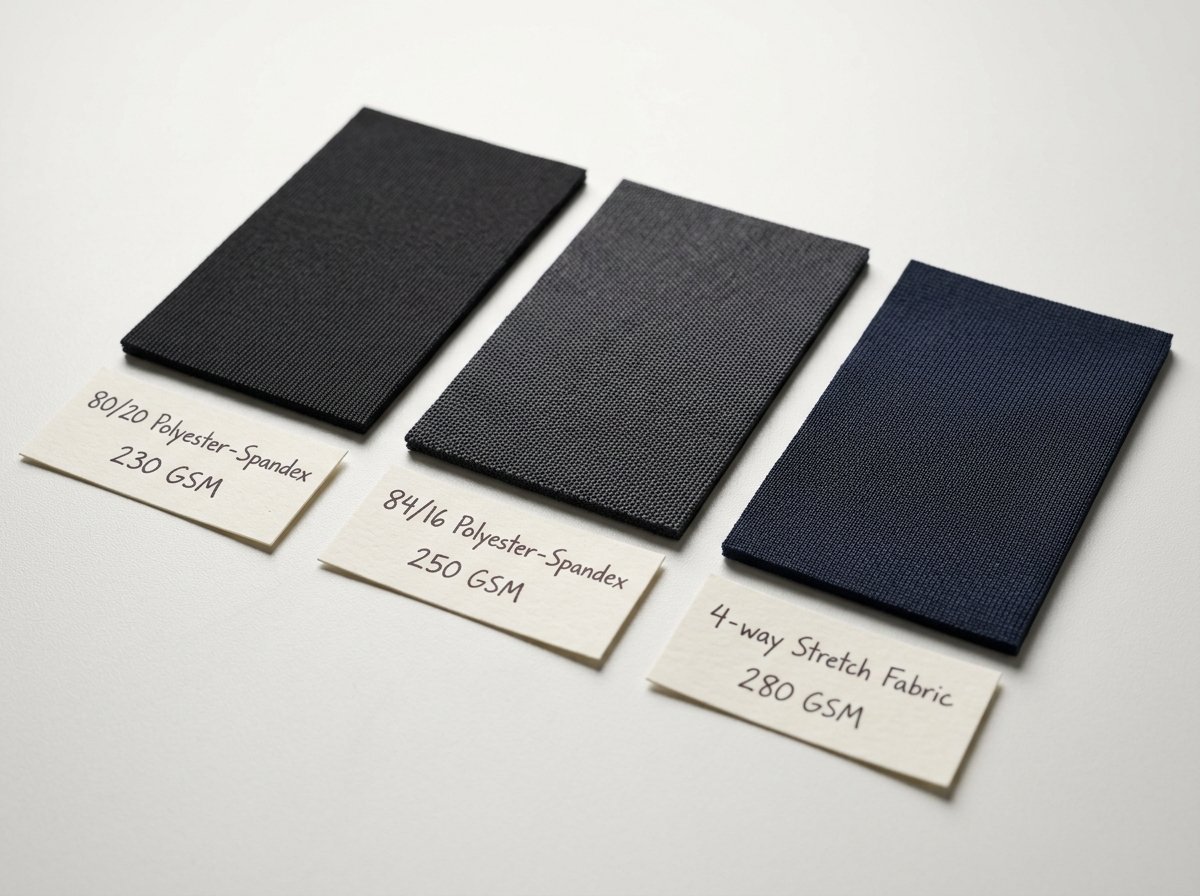
The two most common fabric blends in competitive-grade rash guard production are 80% polyester / 20% spandex (elastane) and 84% polyester / 16% spandex. The difference between these two blends is meaningful — and frequently misunderstood by buyers who have not worked directly with garment manufacturers before.
The 80/20 blend contains more spandex. This translates to greater stretch and recovery — the garment will stretch further and return more quickly to its original shape. However, higher spandex content also reduces colour retention during dye-sublimation printing. Spandex fibres do not accept sublimation dye as readily as polyester fibres. In a fabric with 20% spandex content, you effectively have 20% of the surface that will not hold sublimation ink with the same vibrancy, which can result in slightly duller print saturation compared to an 84/16 blend.
The 84/16 blend compensates by increasing polyester content. This results in better ink saturation and more vibrant, longer-lasting prints — a significant advantage for brands that lead with bold graphic designs. The trade-off is marginally reduced stretch compared to 80/20, although for most practical training applications this difference is negligible with modern 4-way stretch fabric construction.
| Fabric Blend | Stretch Level | Print Vibrancy | Compression Recovery | Best For |
|---|---|---|---|---|
| 80% Polyester / 20% Spandex | Very High | Good | Excellent | High-movement training, wrestling, MMA |
| 84% Polyester / 16% Spandex | High | Excellent | Very Good | Brand-led design-forward BJJ products |
| 88% Polyester / 12% Spandex | Moderate | Excellent | Good | Budget range training garments |
GSM: Why Fabric Weight Defines Perceived Quality
GSM — grams per square metre — measures fabric weight density. For rash guards, this number is directly tied to the garment’s perceived quality, durability, and compression effectiveness.
Lightweight rash guards in the 170–200 GSM range feel thin and breathable, which suits warm-climate training environments or no-gi competitions where minimal material is preferred. However, fabrics in this weight range have a shorter functional lifespan under repeated grappling stress and tend to show wear more quickly.
Mid-weight compression fabrics in the 230–260 GSM range represent the sweet spot for most competitive BJJ and MMA rash guard applications. This weight provides adequate muscle compression, good durability under mat training conditions, and a premium hand-feel that customers notice and respond to. Most established combat sports brands producing at a professional tier specify fabrics within this range.
Heavier fabrics at 270–300 GSM produce a denser, more substantial garment. These are common in cold-climate training applications or where brands specifically market compression support as a primary product feature. The trade-off is reduced breathability and increased heat retention during intense training.
Seam Construction: Why Flatlock Stitching Is Non-Negotiable
Of all the manufacturing decisions that affect a rash guard’s real-world performance, seam construction is the one most frequently overlooked by buyers examining samples in a showroom — and the one they feel most acutely during training.
Flatlock Stitching vs. Overlocked Seams
Conventional overlocked seams — the standard in most garment production — leave a small ridge of folded fabric at the seam. On a typical T-shirt or casual garment, this is completely acceptable. On a rash guard worn in direct skin contact during grappling, that ridge becomes a friction point that causes skin abrasion during extended training sessions. This is not a minor inconvenience. For serious grapplers training multiple sessions per week, poorly seamed rash guards are a legitimate reason to return a product.
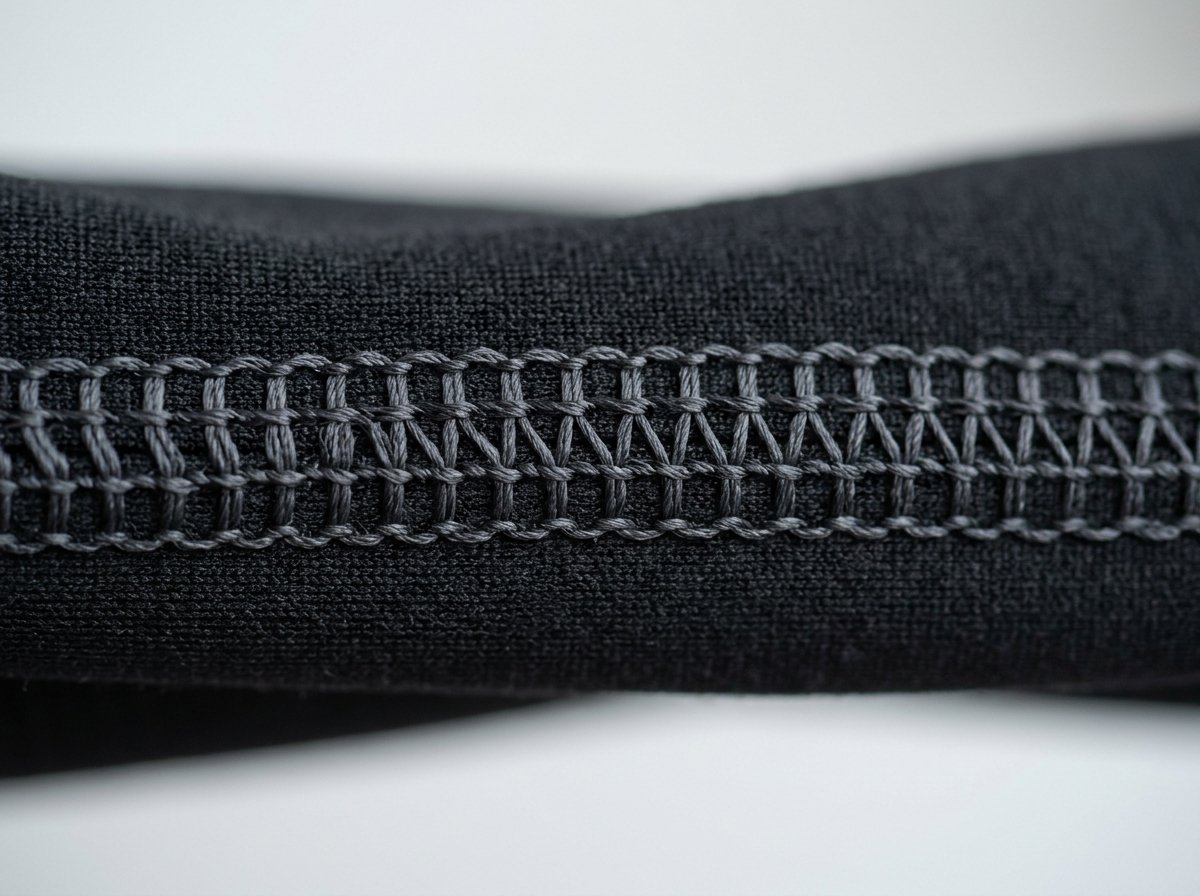
Flatlock stitching solves this problem by joining two fabric panels edge-to-edge rather than folding one over the other. The resulting seam lies completely flat against the body with no raised ridge on either side. This is the standard stitch construction for competition-grade rash guards, and any manufacturer claiming to produce professional BJJ or MMA compression wear should be able to deliver it consistently.
The number of needles in the flatlock stitch matters. A 4-needle flatlock is the baseline for professional-quality rash guards. A 6-needle flatlock provides superior thread coverage across the seam, which directly increases the seam’s resistance to thread breakage under repeated stretch cycling. When requesting samples from any manufacturer, specify 6-needle flatlock as your standard and evaluate the seam under tension before approving production.
Reinforced Panel Construction
Premium rash guard construction incorporates anatomical panel mapping — the garment is cut in multiple panels that follow the natural contours of the body rather than being assembled from simple flat front and back panels. Multi-panel construction allows the stretch zones of the fabric to align with the body’s primary movement directions, reducing resistance during dynamic movement and extending the garment’s functional life.
Side panel construction is particularly important in MMA and no-gi BJJ applications where lateral hip movement and ground-based grappling positions place constant stress on the torso seams. A rash guard built with dedicated side panels and flatlock-stitched torso gussets will outperform a two-panel construction in training longevity under identical conditions.
Sublimation Printing: The Right Process for Permanent Brand Graphics
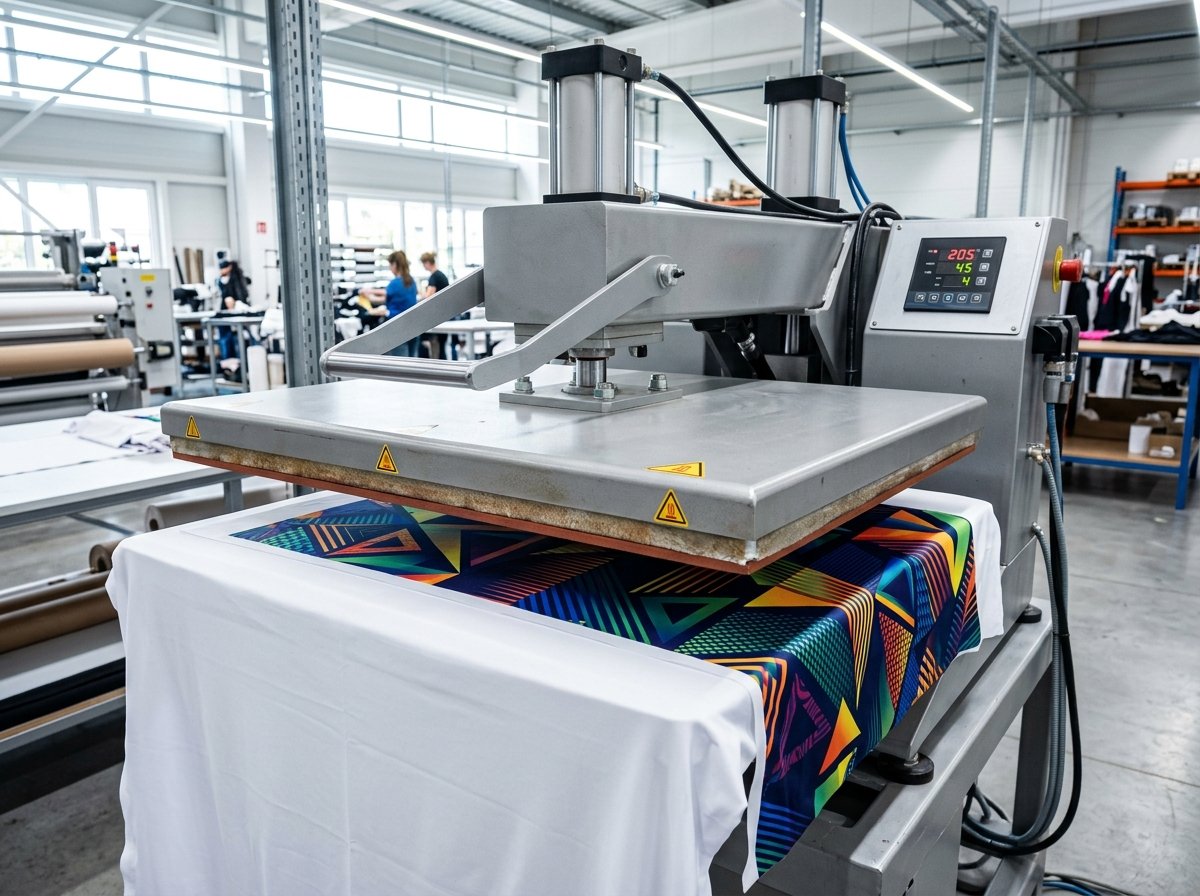
Rash guard branding in combat sports is almost exclusively achieved through dye-sublimation printing, and for good technical reason. Unlike screen printing, which deposits ink on top of the fabric surface, sublimation printing converts solid ink dye into a gas under heat and pressure, permanently bonding it within the polyester fibres at a molecular level. The result is a print that cannot crack, peel, or wash off because it is part of the fabric itself.
How Sublimation Quality Varies Between Manufacturers
Not all sublimation processes produce the same results. The quality of the finished print is determined by three manufacturing variables: ink quality, heat press temperature calibration, and press dwell time. All three must be precisely controlled simultaneously.
Industrial-grade sublimation inks designed specifically for high-stretch sportswear applications are significantly more expensive than general-purpose sublimation inks. Low-cost manufacturers frequently substitute budget inks that produce acceptable colour saturation in initial samples but degrade noticeably faster under repeated 40 degree Celsius washing cycles. The difference in wash-fastness between high-grade and budget sublimation inks can be 30 to 50 washing cycles — a margin that customers will notice and remember.
Heat press temperature for polyester-spandex blends must be carefully calibrated. The optimal range for full dye transfer into polyester fibres typically falls between 185 and 205 degrees Celsius, with dwell times of 35 to 60 seconds depending on fabric weight. If temperature is too low, the dye fails to fully transfer, resulting in faded or streaky prints. If temperature is too high, particularly on high-spandex blends, the elastane fibres begin to degrade — which can permanently affect the fabric’s stretch recovery even if the print looks acceptable in the initial sample.
Cut-and-Sew vs. All-Over Sublimation
There are two primary approaches to sublimation printing in rash guard production. In cut-and-sew sublimation, the fabric roll is printed first and then individual panels are cut from the printed roll and assembled. This is the faster and less expensive method, but it produces seam-area colour misalignment — the design does not continue seamlessly across seam joints.
In panel sublimation, individual panels are cut from unprinted fabric first, and then each panel is printed to a precise design that accounts for the panel’s exact shape and seam placement. The panels are then assembled into the finished garment. This produces a seamless design that wraps continuously around the body with full visual alignment across all seams. Panel sublimation requires more manufacturing precision and adds production time, but is the correct approach for any brand producing premium graphic-forward rash guards.
For buyers sourcing OEM rash guards with bold brand graphics or complex geometric designs, always confirm which sublimation method your manufacturer uses. Panel sublimation should be specified for any order where visual design continuity across seams is commercially important to your brand.
Additional Specifications Buyers Should Not Overlook
Anti-Microbial Treatment
Rash guards worn in mat environments accumulate sweat, bacteria, and skin oils at a high rate. Fabric with a woven-in anti-microbial treatment — commonly achieved through silver-ion integration into the yarn during fibre production — inhibits bacterial growth within the garment, reducing odour between training sessions. This is a meaningful differentiator at the premium end of the market, particularly for brands targeting health-conscious academy owners and professional athletes. Not all manufacturers offer this. Confirm availability during your initial sourcing inquiry.
Waistband and Hem Construction
The waistband of a long rash guard (designed to be tucked or worn beneath a gi) should feature a wide, smooth elastic band that maintains its tension across repeated stretching and washing without rolling or bunching. A 4 to 6 cm fold-over elastic waistband, flatlock-stitched to the main body, is the standard for professional-grade construction. Cheaper alternatives use a narrower binding tape that tends to curl and degrade after 30 to 40 wash cycles.
Sleeve hems and bottom hems should be finished with a blind hem stitch or a 4-needle flatlock hem that maintains fabric elasticity. A poorly finished hem will begin to roll at the edge after a small number of washes, which is both a cosmetic and functional failure point that customers notice quickly.
Woven Labels and Care Labels
For brands building long-term identity in the BJJ and MMA market, the label quality communicates perceived product value before the customer ever puts the garment on. A woven brand label — particularly a silicone-printed label or a soft woven label without a scratchy edge — signals professionalism. A cheap printed paper-tag sewn into the collar suggests cost-cutting, regardless of the quality of the garment itself.
From an OEM perspective, confirm that your factory can produce and attach custom woven labels, hang tags, and neck print branding (for a no-label construction where branding is sublimated directly inside the collar) as part of the production package. Each approach has different cost and lead-time implications that should be discussed during pre-production planning.
The OEM Rash Guard Manufacturing Process: From Design File to Delivery
Understanding the production sequence for a custom OEM rash guard order helps buyers set realistic expectations for timelines, sampling iterations, and minimum order quantities — and helps prevent costly misunderstandings during production.
| Stage | Process | Typical Timeline |
|---|---|---|
| 1. Technical Specification | Buyer submits design files, fabric specs, sizing chart, and branding requirements | 1 to 3 days |
| 2. Pattern Making | Factory creates garment patterns from buyer’s sizing specification or provided tech pack | 3 to 5 days |
| 3. Strike-Off Sample | Factory produces print test on fabric swatch to validate colour accuracy | 2 to 4 days |
| 4. Pre-Production Sample | Full garment sample produced in specified fabric and print for buyer review | 7 to 12 days |
| 5. Sample Approval | Buyer reviews and approves or requests revisions | 3 to 7 days (buyer-side) |
| 6. Bulk Production | Mass production with in-line quality inspection at cutting, stitching, and finishing stages | 20 to 35 days |
| 7. Final QC and Export | Final inspection, packaging, and export documentation | 3 to 7 days |
Total lead time from initial inquiry to shipped order typically falls between 45 and 65 days for a first-time OEM rash guard production run. Repeat orders with previously approved patterns and specifications can be completed in 30 to 40 days depending on current production capacity.
MOQ for OEM Rash Guard Manufacturing
Minimum order quantities for OEM rash guard production typically start at 50 to 100 pieces per style for established manufacturers willing to work with growing brands. Larger factories may require 200 to 300 pieces per style to justify the setup costs of a new pattern and print configuration.
For buyers evaluating multiple designs or colour variants simultaneously, MOQ is usually calculated per style-colour combination, not across the total order. Brands launching with three colourways of a single design should plan for the MOQ to apply separately to each colour run. This is worth clarifying explicitly with your manufacturer before finalising your range.
Choosing the Right OEM Rash Guard Manufacturer: Key Evaluation Criteria
The global sportswear manufacturing industry is large. Factories producing compression garments exist across Pakistan (particularly Sialkot and Lahore), Bangladesh, China, Thailand, and increasingly in Vietnam and Cambodia. The question for a buyer is not simply which country to source from — it is how to evaluate a specific factory’s capability to produce competition-grade rash guards consistently.
The Buyer’s Evaluation Checklist
- Can the factory provide fabric data sheets confirming polyester-spandex composition and GSM values?
- Does the factory produce using flatlock stitching as a standard offering, or only on request at a premium?
- What sublimation printing method does the factory use — cut-and-sew or panel sublimation?
- Can the factory demonstrate wash-fastness testing data, or can it produce wash-cycle sample sets for evaluation?
- Does the factory conduct in-line quality control at each production stage (cutting, stitching, finishing, packaging)?
- What is the factory’s capacity for adding anti-microbial fabric treatment?
- Can the factory supply custom woven labels, neck print branding, and custom packaging?
- Does the factory have experience producing for established combat sports brands — and can it reference prior production?
- What are the factory’s export documentation capabilities for international shipping?
A manufacturer that can answer these questions clearly and provide physical evidence — fabric data sheets, seam sample cards, wash-cycle test garments — is demonstrating the kind of production discipline that leads to consistent quality in bulk orders. A manufacturer that responds to these questions with vague reassurances is a significant risk to your brand and your investment.
Private Label vs. Full OEM: Which Route Is Right for Your Brand?
Buyers approaching rash guard manufacturing for the first time sometimes conflate private label and full OEM production. Both routes can produce high-quality garments, but the investment, lead time, and creative flexibility they offer are meaningfully different.
Private label production typically means sourcing a garment style that the manufacturer already produces — a stock pattern, a proven fabric specification — and applying your brand’s logo and colourway to it. This approach reduces sampling time, lowers MOQ requirements, and gets your product to market faster. The limitation is design differentiation: if the same factory sells the same base garment to multiple brands, your product’s distinctiveness relies entirely on your graphic design and branding execution.
Full OEM production begins from your specification. Your tech pack determines the pattern, the fabric, the seam construction, and every detail of the finished garment. The factory manufactures exclusively to your requirements. This route demands more upfront investment — in design development, tech pack preparation, and sampling iterations — but produces a product that is genuinely proprietary to your brand and difficult for competitors to replicate directly.
For brands in early stages with limited capital, private label production is the pragmatic starting point. For brands already generating consistent volume who are ready to compete on product quality rather than price, full OEM is the natural progression. A factory capable of supporting both routes is the ideal long-term manufacturing partner.
Packaging, Quality Control, and Export Readiness
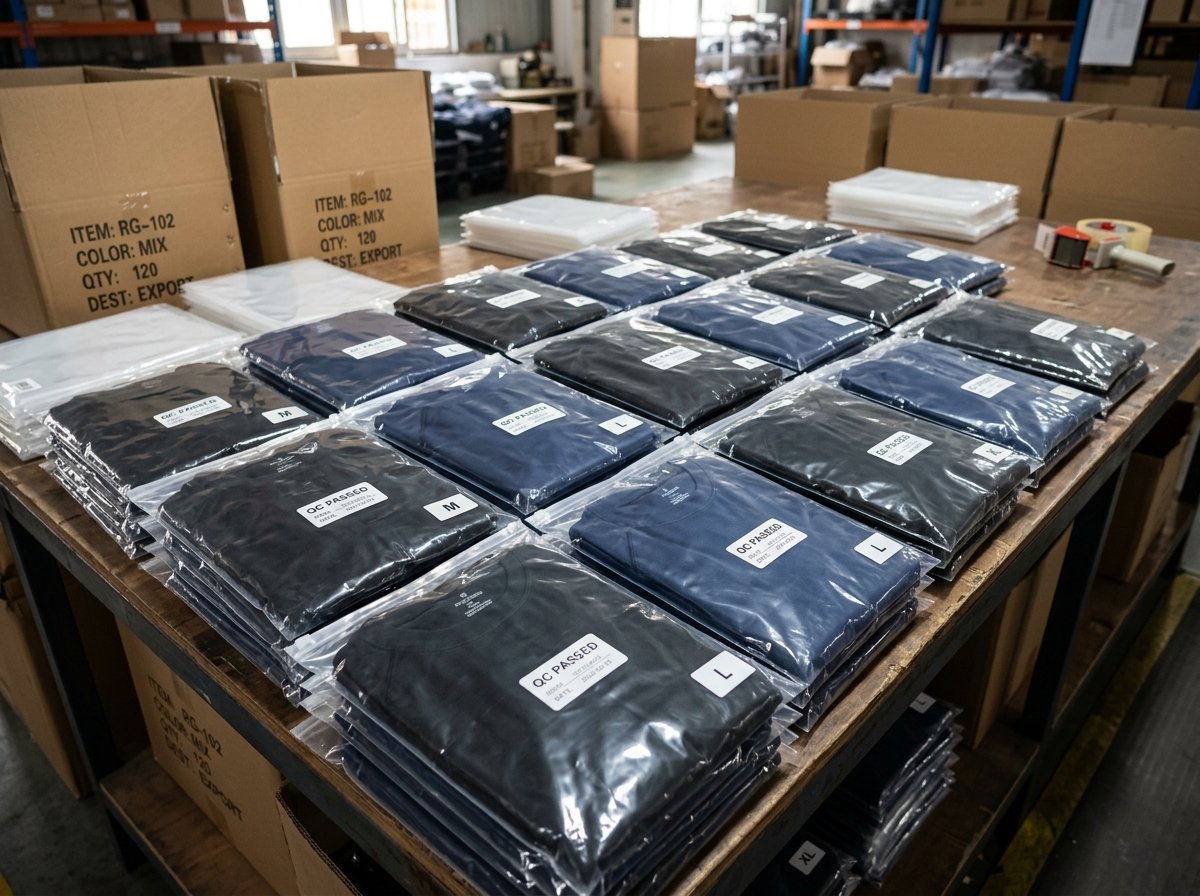
Packaging for rash guard OEM export orders follows a straightforward standard. Individual garments are folded and sealed in transparent polybags, tagged with the buyer’s label specifications. Polybags are then consolidated into export master cartons, typically with 12 to 24 units per carton depending on garment size. Carton dimensions and gross weight are confirmed to the buyer for freight planning before shipment.
A competent OEM rash guard manufacturer should be able to prepare full export documentation without significant involvement from the buyer — including commercial invoice, packing list, certificate of origin, and airway bill or bill of lading depending on the shipping mode chosen. Buyers importing into markets with specific textile import compliance requirements should confirm that the factory’s documentation capabilities meet those standards before committing to a production run.
Shipping compression garments by air freight is common for urgent or smaller orders due to the relatively low weight-to-value ratio of finished rash guards. Larger bulk orders are typically consolidated into LCL (less-than-container-load) or FCL (full-container-load) sea freight shipments, which significantly reduce per-unit logistics cost for high-volume buyers.
Before approving bulk production of any OEM rash guard order, confirm the following items in writing with your manufacturer:
- Fabric composition certificate (polyester/spandex ratio and GSM)
- Seam type confirmation (flatlock — 4-needle or 6-needle)
- Sublimation method (cut-and-sew vs. panel sublimation)
- Wash-fastness test standard (minimum 40 cycles at 40 degrees Celsius)
- In-line QC process at cutting, stitching, and finishing stages
- Label and packaging specification approval
- Export documentation list and timeline
Conclusion
Custom rash guard manufacturing is not particularly complex — but it is unforgiving when buyers skip the technical details. Fabric blend, GSM, seam construction, sublimation method, and label quality are not interchangeable. Each one contributes to the product experience your customers will have in training, and collectively they determine whether your brand earns repeat orders or product return requests.
The buyers who build durable combat sports brands in BJJ and MMA apparel are the ones who approach OEM manufacturing with the same discipline that their customers apply to training — methodically, with a clear understanding of what quality actually looks like, and a willingness to reject work that does not meet specification.
If you are ready to discuss rash guard OEM manufacturing — whether you need a private label starter range or a full custom production program — the Pentapunch team is ready to answer your technical questions and help you build a product your customers will train in for years.
Frequently Asked Questions
Ready to Source Custom Rash Guards?
Pentapunch manufactures OEM and private label rash guards for BJJ brands, MMA fightwear labels, and combat sports importers worldwide. Request a quote or speak directly with our team today.

One thought on “Custom Rash Guard Manufacturer: BJJ & MMA Sourcing Guide”