Blog
How to Vet a Boxing Gloves Manufacturer: A Private Label Buyer’s Due Diligence Checklist

Every boxing gloves manufacturer in Sialkot says roughly the same thing: premium materials, low MOQ, worldwide shipping, factory-direct pricing. Scroll through ten supplier websites and the language barely changes. So how do you actually tell a reliable production partner from a factory that will miss deadlines, cut corners on padding, or disappear after taking a deposit?
The answer isn’t in the marketing copy. It’s in a handful of specific, verifiable details that most buyers never think to ask about until after something has already gone wrong. This guide walks through exactly what to check, what to ask, and which answers should make you pause before signing a purchase order.
 Why Vetting Matters More Than Comparing Prices
Most private label buyers start their search by comparing quotes. That’s a mistake, and it’s the single biggest reason first orders go badly. Two factories can quote the same price per pair of gloves and deliver completely different products, because price doesn’t tell you anything about padding consistency, stitching durability, or whether the factory will still answer your emails after receiving payment.
A cheap quote from an unverified factory is not a discount. It’s a deferred cost that shows up later as returned inventory, unhappy retail customers, or a shipment held at customs because the paperwork was incomplete. Vetting a manufacturer properly, before the first purchase order, is what actually protects your margin.
Step 1: Confirm You’re Dealing With a Real Manufacturer
Sialkot has a dense mix of factories, trading houses, and middlemen who resell factory output under their own branding. None of these arrangements are inherently dishonest, but you need to know which one you’re working with, because it changes everything about pricing, quality control, and accountability.
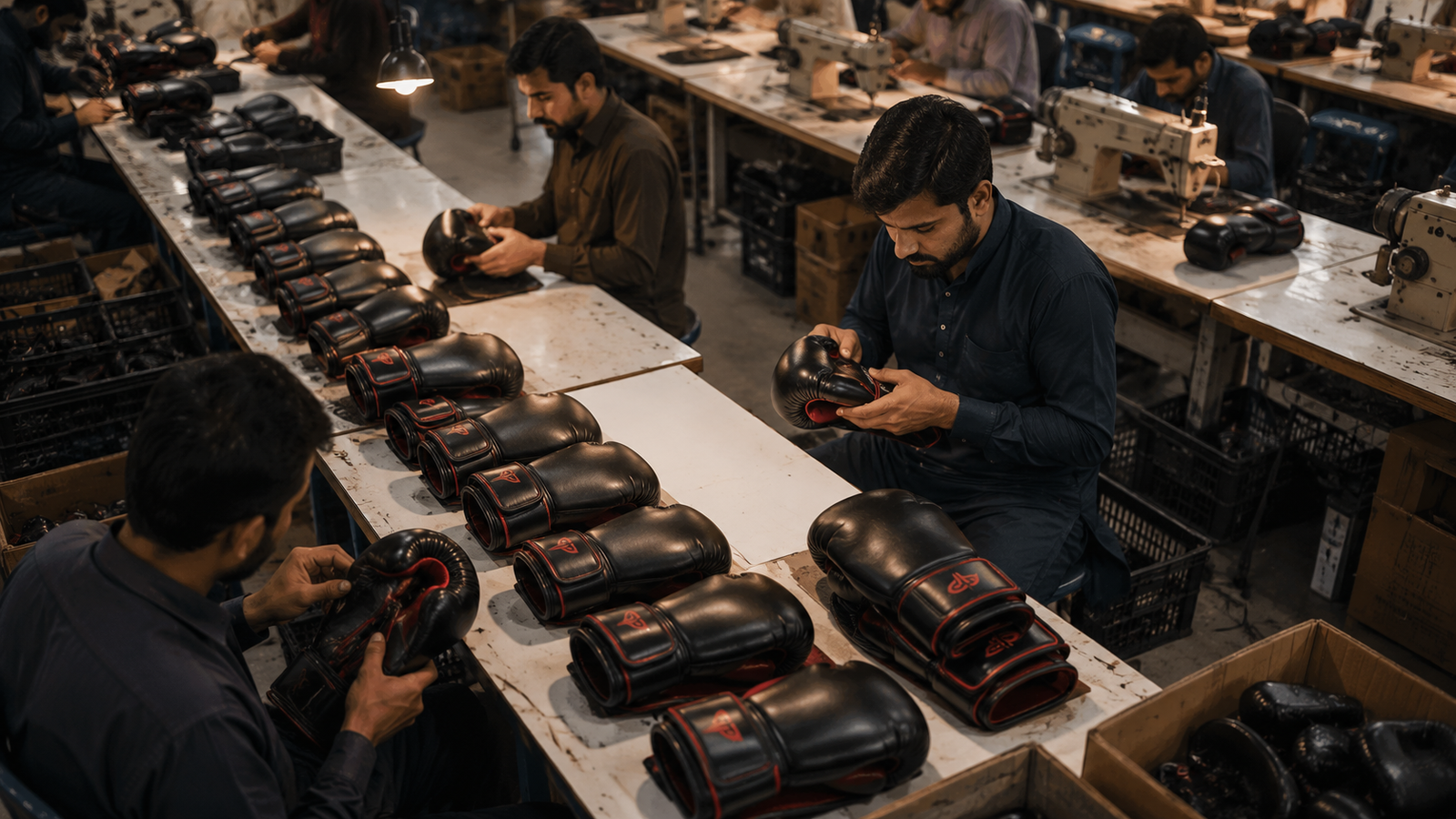
Ask directly: does the company own and operate its own production facility, or does it source finished gloves from other factories? A legitimate manufacturer should be willing to answer this without hesitation, and ideally offer photos or a video call showing the actual production floor — not stock photography borrowed from an industry catalogue.
Watch for generic factory photos reused across multiple supplier websites. If the same cutting table or stitching machine appears on three different “manufacturer” sites with different company names, you’re looking at a trading company, not a factory.
Step 2: Ask for a Documented Quality Control Process
“Strict quality control” appears on almost every manufacturer’s homepage. It means very little without specifics. A real QC process should be describable in concrete stages, not a single vague sentence.
Ask what happens at each of these points:
- Incoming material inspection is leather or PU checked for consistency before cutting begins?
- Mid-production checks are stitching, padding density, and thumb attachment inspected during assembly, or only at the end?
- Final inspection before packing is every pair checked, or is inspection based on random sampling?
- Defect handling what happens to a pair that fails inspection? Is it reworked, or discarded?
A manufacturer that can answer these questions specifically, with numbers and stages, is operating a real system. A manufacturer that repeats “we guarantee premium quality” without describing the process is asking you to trust a claim you can’t verify.

Export-ready shipment with documentation
Step 3: Test Sample Transparency Before Committing
Pre-production samples exist for one reason: to let you evaluate the actual product before committing to bulk quantities. How a factory handles the sampling stage tells you almost everything about how they’ll handle your full order.
A transparent sampling process includes a clear cost (samples are rarely free, and factories that offer them for free with no clear terms are often compensating in other ways), a realistic timeline communicated upfront, and a willingness to make revisions if the first sample doesn’t match your specification.
Pay attention to how closely the sample matches what you actually asked for. If you specified 12oz gloves with multi-layer foam and genuine leather, and the sample arrives with unclear padding density or a different material than discussed, that’s not a small issue to overlook — it’s a preview of how bulk production will be handled.
Step 4: Evaluate Communication Standards
Response time and clarity during the inquiry stage are a reliable predictor of what production communication will look like once your money is committed. A factory that takes days to answer a simple product question, or gives vague, copy-pasted responses, is unlikely to become more responsive once an order is confirmed.
Look for specificity in their answers. If you ask about padding density and the reply only repeats “high quality multi-layer foam” without engaging with your actual question, that’s a signal the person responding may not have direct production knowledge — which matters if problems come up mid-order.
Step 5: Check Material Sourcing and Customization Depth
Genuine leather, PU leather, microfiber, and high-density foam are standard materials across the industry, but sourcing quality varies significantly between factories, even within the same city. Ask where leather is sourced and whether the factory can provide material samples separately from the finished product sample — a small swatch is often enough to compare against a competing quote.
Also test how deep their customization actually goes. Any factory can add a printed logo. Fewer can execute embroidery, sublimation printing, silicone labels, and Pantone-matched color consistency across a full production run without shade variation between batches. If branding consistency matters to your product line, ask specifically how color matching is maintained batch to batch.
Step 6: Understand How MOQ Is Actually Structured
Minimum order quantities are quoted everywhere, but the number alone tells you very little. MOQ depends on material, customization complexity, number of colors, and number of sizes — a single-color, single-size order will always have a lower realistic minimum than a multi-size, multi-color product line, even if the advertised MOQ is the same.
Ask how MOQ is calculated for your specific product, not the generic number listed on the website. A factory that gives you a straight, itemized answer — broken down by style, color, and size — is demonstrating real production planning. A factory that repeats the marketing MOQ figure without adjusting for your actual specification hasn’t engaged with your project yet.
Step 7: Confirm Export Experience and Documentation
Manufacturing quality and export competence are two different skills, and a factory can be strong in one without being reliable in the other. Ask about experience shipping to your specific target market — the USA, UK, Europe, Australia, or the Middle East each carry different documentation, labeling, and customs requirements.
Confirm whether the factory handles commercial invoices, packing lists, and any country-specific compliance documentation directly, or whether that responsibility falls on you. This is a detail that gets overlooked until a shipment is delayed at customs — by then, it’s too late to renegotiate who’s responsible.

Export-ready shipment with documentation
Red Flags That Should Make You Walk Away

A Practical Due Diligence Checklist

How Pentapunch Approaches Manufacturer Transparency
Pentapunch operates as a direct manufacturer in Sialkot, working across OEM, ODM, and private label production for boxing gloves, MMA gear, and wider combat sports equipment. Buyers evaluating a new supplier are welcome to ask the same questions covered in this guide — material sourcing, quality control stages, sampling process, and export documentation — before committing to an order.
If you’re comparing manufacturers for an upcoming private label or wholesale project, reach out at info@pentapunch.com or WhatsApp +92 321 7660939 to discuss your specification directly.
Frequently Asked Questions
How do I know if a boxing gloves manufacturer is legitimate?
Ask for factory photos or a live video call of the production floor, request a documented quality control process, and check whether they can answer specific material and construction questions rather than repeating generic marketing language.
Should I always request a sample before placing a bulk order?
Yes. A pre-production sample lets you verify material, padding density, and construction against your specification before committing to a full production run, and it reveals how the factory handles revisions if something doesn’t match.
Why does MOQ vary between factories quoting the same product?
MOQ depends on material type, number of colors, number of sizes, and customization complexity — not just the product category. A single-color order will always carry a lower realistic minimum than a multi-size, multi-color line.
What export documentation should a manufacturer handle?
At minimum, commercial invoices and packing lists. Country-specific requirements vary, so confirm upfront whether the factory manages compliance documentation for your target market or whether that responsibility sits with you.
Is a lower price always a red flag?
Not automatically, but a significantly lower quote paired with vague answers about quality control or unwillingness to provide a sample is a combination worth treating with caution.