
Blog
MMA Fight Shorts Manufacturer: Fabric, Print & Seam Guide

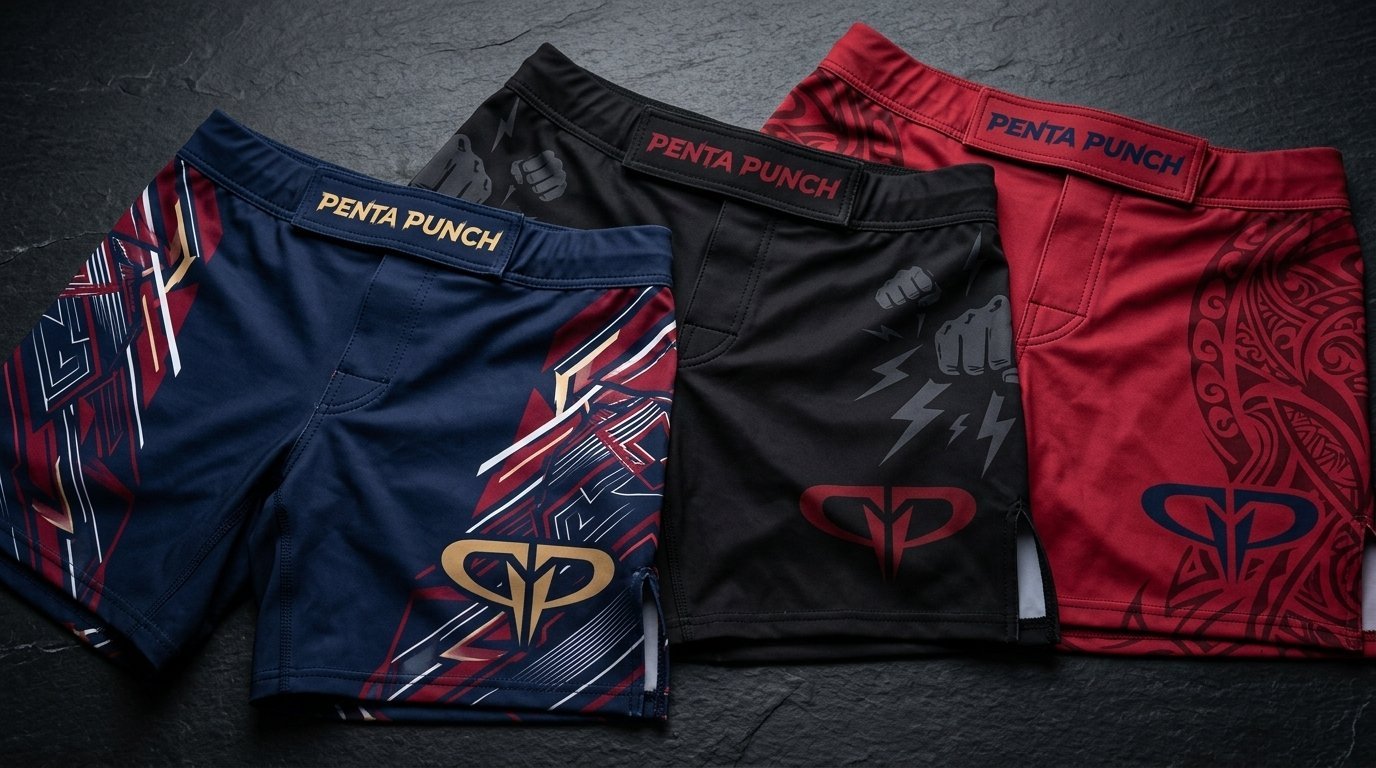
For any fightwear brand entering the MMA apparel market, product quality begins long before the first order ships. Combat shorts endure relentless stress — high kicks, takedowns, ground-and-pound exchanges, and hours of rolling on abrasive canvas. An ill-engineered short will split at the seam, fade after six washes, or restrict a fighter’s hip rotation at the worst possible moment.
Sourcing custom MMA fight shorts through an OEM manufacturer gives brand owners control over every performance variable: fabric GSM, sublimation ink penetration depth, seam construction type, waistband elasticity, and split-side cut geometry. This guide walks international importers, Amazon sellers, and combat sports brand managers through the core manufacturing decisions that determine whether a fight short performs at the professional level or fails in the first training cycle.
Why MMA Fight Short Engineering Matters for Wholesale Buyers
The global MMA apparel market continues to expand as mixed martial arts gains mainstream traction. Brands entering this space face one defining challenge: consumer expectations are set by elite professional-grade fight shorts. Cheap domestic gym shorts cut from incorrect materials — regardless of how premium the printing looks — will fail during the first serious training session.
The most common reason MMA shorts fail in retail is not poor design — it’s incorrect fabric weight selection and low-penetration sublimation printing that fades rapidly under sweat and UV exposure.
Common quality failures wholesalers encounter when sourcing from unvetted suppliers include:
- Restricted Hip Mobility: Insufficient 4-way stretch causing seam tear during high kicks or guard work.
- Sublimation Fading: Surface-level ink application washing out after 8–10 training sessions.
- Waistband Rollover: Weak elastic or incorrect waistband channel width causing constant readjustment during rolling.
- Inner Seam Abrasion: Overlock stitching (rather than flatlock) causing skin irritation during ground game.
- Slit Split Failures: Side slits with insufficient reinforcement tearing open at the pivot point during kicks.
Fabric Selection: GSM, Composition & 4-Way Stretch Standards
The outer shell fabric is the foundation of every MMA fight short. The correct combination of polyester-to-spandex ratio and GSM (grams per square metre) weight determines how the garment performs under extreme athletic stress.
Recommended Fabric Composition
| Fabric Spec | Entry-Level Tier | Mid-Range Tier | Pro Competition Tier |
|---|---|---|---|
| Composition | 100% Polyester | 90% Polyester / 10% Spandex | 85% Polyester / 15% Spandex |
| GSM Weight | 120–140 GSM | 155–175 GSM | 180–210 GSM |
| Stretch Direction | 2-way | 4-way | 4-way (superior recovery) |
| Sublimation Suitability | Low (surface fade) | High | Excellent (deep ink lock) |
| Target Market | Gym retail, casual | Training, Amazon FBA | Competition, premium brand |
For commercial gym supply and Amazon FBA lines, a 90/10 polyester-spandex blend at 160–175 GSM provides the optimal balance between cost efficiency and performance longevity. For premium brand positioning, a 85/15 blend at 190–210 GSM delivers professional-grade recovery, stretch, and sublimation depth.

Fabric GSM weight directly determines fight short performance durability and sublimation print quality depth.
Sublimation Printing: Ink Penetration, Colour Fastness & Design Resolution
Sublimation printing is the industry standard for MMA fight shorts because it permanently bonds dye into the polyester fibre rather than sitting on the surface like screen printing or heat-transfer vinyl. Done correctly, sublimation produces vibrant, wash-resistant graphics that remain fully intact after hundreds of training sessions.
Key Sublimation Quality Criteria
- Print Temperature: Commercial-grade sublimation requires 190–210°C press temperature for full dye penetration. Lower temperatures leave dye at the surface level, causing rapid fading.
- Press Time: Minimum 45–60 second dwell time is required for complete dye sublimation into polyester fibres.
- Resolution Standard: Artwork files must be supplied or prepared at minimum 150 DPI (at final print size) to prevent pixelation visible on the garment surface.
- Colour Fastness Rating: ISO 105-C06 wash fastness testing should confirm a minimum Grade 4 colour retention rating for commercial export apparel.
- All-Over Print (AOP) Seam Alignment: Premium shorts require matched sublimation panels — ensuring print continuity across seam joins at the side seam and crotch panel.
Always request a physical strike-off sample before approving mass production. On-screen Pantone colour matching and final sublimated fabric output can differ by up to 15–20% without calibrated press equipment.

Precision-temperature sublimation printing permanently bonds ink deep into polyester fibres, producing wash-resistant graphics.
Seam Engineering: Flatlock vs. Overlock & Side Split Construction
Seam construction is one of the most commonly overlooked factors in MMA fight short sourcing. The wrong seam type causes three critical failures: skin abrasion during ground work, restricted mobility, and premature seam failure under explosive movement.
Flatlock vs. Overlock Seam Comparison
| Feature | Flatlock Stitch | Overlock / Serger Stitch |
|---|---|---|
| Seam Profile | Flat against skin — zero raised ridge | Raised seam edge — causes abrasion |
| Stretch Recovery | Excellent — moves with the fabric | Moderate — can restrict high kicks |
| Skin Comfort | No irritation during ground work | Can cause rash on inner thigh |
| Production Cost | Slightly higher (specialised machine) | Lower |
| Recommended For | Professional / mid-range MMA shorts | Budget or casual gym apparel only |
Side Split Engineering
All professional MMA fight shorts feature a side split or split-seam construction that eliminates hip restriction during round kicks. Key specifications include:
- Split Depth: 10–14 cm split depth from the hem is standard for full Thai-style high kick clearance.
- Reinforcement Bartack: A double-bartack stitch at the split pivot point prevents tear propagation under explosive kicks.
- Internal Board Short Liner: Premium competition shorts feature an integrated elastic compression liner that prevents exposure during ground positions.

Flatlock seam construction lies completely flat against skin — eliminating abrasion during ground work and maximising range of motion.
Flatlock seam construction lies completely flat against skin — eliminating abrasion during ground work and maximising range of motion.
Waistband Construction, Closure Systems & Drawcord Engineering
The waistband is the structural anchor of every fight short. Under the physical intensity of MMA training, waistbands must retain their position during takedowns, clinch work, and ground-and-pound without requiring constant readjustment.
- Elastic Band Width: Minimum 4 cm woven elastic for training shorts. Competition shorts typically use 5–6 cm wide waistband for maximum support surface area.
- Drawcord Material: Flat woven nylon drawcord (8–10 mm width) with moulded plastic cord-lock — prevents cord pullout during submission attempts.
- Velcro Fly Closure: Grade 4 hook-and-loop Velcro (minimum 10 cm width) at the front fly prevents accidental opening and reduces grab opportunities for opponents.
- Waistband Tunnel Stitching: Triple-needle stitching at the elastic channel prevents tunnel separation and waistband rollover under continuous pulling forces.
OEM Manufacturing Workflow: Tech Pack to Bulk Production
Working with Pentapunch’s OEM apparel team follows a structured, milestone-based process that prevents costly bulk production errors.
Step 1: Tech Pack & Artwork Submission
Buyers provide a tech pack defining construction specifications (GSM, composition, seam type, split depth, pocket detail, waistband spec) alongside high-resolution artwork files (Adobe Illustrator vector format preferred) with Pantone colour references.
Step 2: Strike-Off Sample & Fit Approval
A physical strike-off (fabric print test) and sewn fit sample are produced in one size grade. The buyer reviews colour accuracy, seam flatness, waistband hold, and split geometry before providing written sign-off.
Step 3: Size Grade Production & QC
Upon sample approval, the full size run (XS through 4XL) is graded and produced. Quality control audits each unit for seam alignment, print registration, measurement accuracy, and waistband tension before packing.
Custom MMA Fight Shorts Manufacturing with Pentapunch
Pentapunch provides end-to-end OEM, ODM, and Private Label manufacturing of MMA fight shorts and combat apparel for international brands, wholesalers, and Amazon FBA sellers. Our Sialkot manufacturing operations support full sublimation printing, flatlock seam construction, custom packaging, and export-compliant FBA preparation.
Contact Pentapunch’s apparel team today to request fabric swatches, review MOQ structures, or submit your tech pack for a free production feasibility assessment.
FAQ
Frequently Asked Questions
Q. What is the minimum order quantity for custom MMA fight shorts?
Minimum order quantities vary based on the complexity of the design and fabric selection. Standard MOQs typically begin at 100–200 pieces per design for sublimation printed shorts, with lower MOQs available for ODM white-label programs where pre-approved base patterns are used.
Q. What fabric GSM is recommended for Amazon FBA MMA fight shorts?
For Amazon FBA and mid-range wholesale channels, a 90% polyester / 10% spandex blend at 160–175 GSM offers the optimal balance between production cost, sublimation vibrancy, and durability. This specification consistently produces positive customer reviews for training wear.
Q. Can Pentapunch supply fight shorts with an integrated compression liner?
Yes. We manufacture competition-grade fight shorts with an integrated elastic compression liner (typically 80% nylon / 20% spandex) stitched to the interior waistband. This feature is standard on professional-tier product lines.
Q. How long does production take from tech pack approval to shipment?
Standard lead time from tech pack approval to shipment is typically 30–45 days for initial production runs, including sample production (7–10 days), approval review, and mass production. Rush production timelines can be discussed based on order volume.
Q. Does Pentapunch provide FBA-ready packaging for fight shorts?
Yes. We provide complete Amazon FBA preparation services including polybag packaging with suffocation warning compliance, custom header cards, individual FNSKU barcode labelling, and carton preparation meeting Amazon’s inbound shipment requirements.